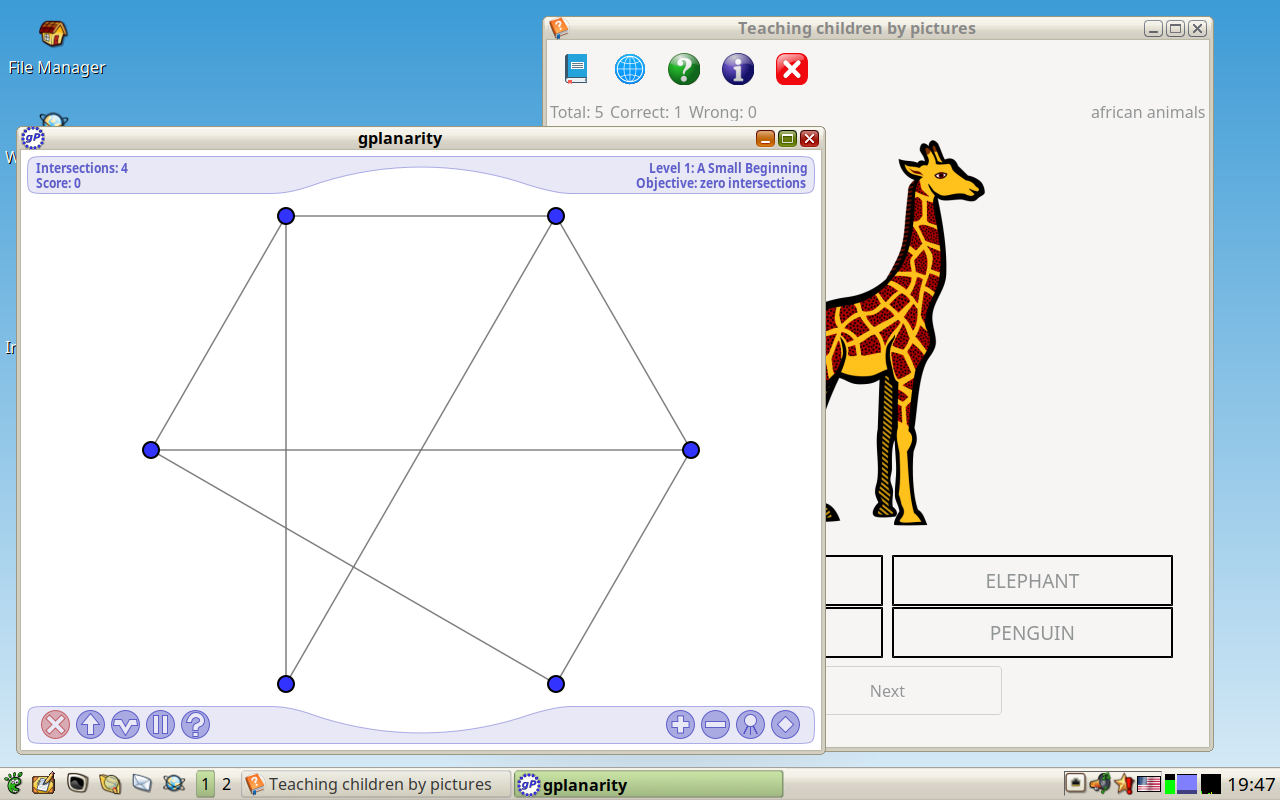
Untangle the chaos by moving connected points to minimise crossings.
gPlanarity
Mathematical puzzles and logic games
Graph theory calls points vertices and connections edges. A planar graph can be drawn without crossings. Some puzzles ask for the best achievable solution. Group movement, intersection highlighting, board resizing, level selection and saved board states provide varied challenges. Draw a network on paper and compare strategies.
Understanding the puzzle
The board contains points connected by lines. Move one point and watch its attached lines follow. Connections remain unchanged. Depending on the challenge, remove every crossing or reduce their number as much as possible. Fast solutions may earn bonus points.
Developing strategies
Start with an outside point and see whether moving it removes several crossings. Look for small groups whose connections can be arranged clearly. Change one part of the network at a time and compare the result. Try a different arrangement when an approach fails.
Tools and variations
gPlanarity extends the original Planarity game with group selection and dragging, board resizing, level selection and reset. Lines can be hidden and intersections highlighted. Different generation algorithms and objectives provide variety. Saved board states let players return to puzzles later.
Discovering graph theory
Mathematicians call the points vertices and the connections edges. A graph is planar if it can be drawn without edge crossings. What matters is which vertices are connected, not their initial positions. Not every graph is planar, so some challenges ask for the best achievable arrangement.
A classroom experiment
Draw four points and connect every pair. Then arrange three points as a triangle with the fourth inside. All connections can be drawn without crossing. Compare this with a square and its diagonals. Discuss why the connections remain identical even though the picture changes.